Research Topics
My research is primarily focused on detection and attribution of how anthropogenic climate change—and emissions from large, industrial carbon producers— have contributed to western US hydroclimate impacts, including impacts on water, agriculture, and fire risk. I am additionally working on energy accountability, specifically focused on electric utilities and powerline fires. I am most drawn to interdiscplinary, applied research, primarily at the intersection of climate science, policy, and law, with the goal of producing actionable science that supports communities, policymakers, and courts in addressing climate change.
Source-to-Impact Attribution
Climate attribution science--or quantifying the contribution of human-caused climate change on observed trends and events--has only been around for a couple of decades. However, this field of study has rapidly expanded, with new frontiers in conducting impact attribution (quantifying how much of impacts are due to climate change) and source attribution (quantifying the contribution of individual or groups of emitters to those impacts). I am interested in the types of impacts that can be brought into this body of research, as well as expanding the methodological base for how this research can be done.
Climate Change & Drought
I am interested in the hows, whys, and so-whats of climate change impacts on the WUS hydroclimate. Specifically: how does hydroclimate in the WUS unfold, why is hydroclimate changing, and what are the implications of these changes for climate policy and law? To address these questions, my research leverages large geospatial data (e.g., global climate models, reanalysis data, and land cover data) to quantify the impact of climate change on WUS hydroclimate through detection and attribution methodologies.


Energy Infrastructure & Risk
I am drawn to data-driven research on energy accountability given the relationships between energy and climate change and the disproportionate impacts of both on specific communities. I am currently leading research on fires that begin as powerline ignitions in California.
Peer-Reviewed Articles
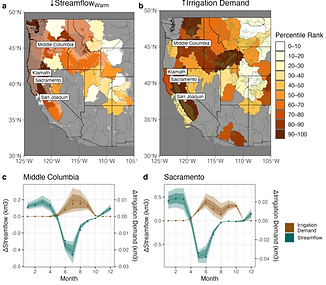
Williams, E. L., & Abatzoglou, J. T. (2025). Climate change increases evaporative and crop irrigation demand in North America. Earth's Future, 13(7), e2025EF005931. https://doi.org/10.1029/2025EF005931
Abatzoglou, J. T., Kolden, C. A., Cullen, A. C., Sadegh, M., Williams, E. L., Turco, M., & Jones, M. W. (2025). Climate change has increased the odds of extreme regional forest fire years globally. Nature Communications, 16(1), 6390. https://doi.org/10.1038/s41467-025-61608-1
Fernandez-Bou, A. S., Rodriguez-Flores, J. M., Ortiz-Partida, J. P., Fencl, A., Classen-Rodriguez, L. M., Yang, V., Williams, E.L., ... & Nuñez-Bolaño, Y. (2025). Cropland repurposing as a tool for water sustainability and just land transition in California: review and best practices. Frontiers in Water, 7, 1510413. https://doi.org/10.3389/frwa.2025.1510413
Jorge, A. L., Abatzoglou, J. T., Fleishman, E., Williams, E. L., Rupp, D. E., Jenkins, J. S., ... & Short, K. C. (2025). COVID‐19 fueled an elevated number of human‐caused ignitions in the western United States during the 2020 wildfire season. Earth's Future, 13(4), e2024EF005744. https://doi.org/10.1029/2024EF005744
Abatzoglou, J. T., Parker, L. E., Viers, J. H., Medellín-Azuara, J., Escriva-Bou, A., Huntington, J. L., Williams, E.L., & Rajagopalan, K. (2025). Shorter growing seasons may moderate climate change effects on crop water demands. Environmental Research Letters, 20(3), 034017. https://doi.org/10.1088/1748-9326/adb1f5
Abatzoglou, J. T., Fleishman, E., Williams, E. L., Rupp, D. E., Jenkins, J. S., & Sadegh, M. (2024). The Efficacy of Red Flag Warnings in Mitigating Human-Caused Wildfires across the Western United States. Journal of Applied Meteorology and Climatology, 63(12), 1511-1521. https://doi.org/10.1175/JAMC-D-24-0120.1
Williams, E. L., Abatzoglou, J. T., Hegewisch, K. C., & Williams, A. P. (2024). Anthropogenic climate change has reduced drought recovery probabilities across the western US. Communications Earth & Environment, 5(1), 546. https://doi.org/10.1038/s43247-024-01640-z
Williams, E., Funk, C., Peterson, P., & Tuholske, C. (2024). High resolution climate change observations and projections for the evaluation of heat-related extremes. Scientific Data, 11(1), 261. https://doi.org/10.1038/s41597-024-03074-w
Williams, E. L., Funk, C., & Shukla, S. (2023). Anthropogenic climate change negatively impacts vegetation and forage conditions in the greater four corners region. Earth's Future, 11(7), e2022EF002943. https://doi.org/10.1029/2022EF002943
Funk, C., Harrison, L., Segele, Z., Rosenstock, T., Steward, P., Anderson, C. L., … Williams, E.L., ... & Hughes, D. (2023). Tailored forecasts can predict extreme climate informing proactive interventions in East Africa. Earth's Future, 11(7), e2023EF003524. https://doi.org/10.1029/2023EF003524
Williams, E. L., Bartone, S. A., Swanson, E. K., & Stokes, L. C. (2022). The American electric utility industry’s role in promoting climate denial, doubt, and delay. Environmental Research Letters, 17(9), 094026. https://doi.org/10.1088/1748-9326/ac8ab3
Pellow, D. N., Williams, E., & Rizo-Centino, A. R. (2022). Collaborative Research and Action for Climate Justice in California. Capitalism Nature Socialism, 1-18. https://doi.org/10.1080/10455752.2021.2007538
Williams, E. (2019). Attributing blame?—climate accountability and the uneven landscape of impacts, emissions, and finances. Climatic Change, 1-18. https://doi.org/10.1007/s10584-019-02620-5
Williams, E., Funk, C., Shukla, S., McEvoy, D. (2020). Quantifying Human-Induced Temperature Impacts on the 2018 United States Four Corners Hydrologic and Agro-Pastoral Drought. Bulletin of the American Meteorological Society, 101(1), S11-S16. https://www.jstor.org/stable/27032737
Brown, M. E., Funk, C., Pedreros, D., Korecha, D., Lemma, M., Rowland, J., Williams, E.L., & Verdin, J. (2017). A climate trend analysis of Ethiopia: examining subseasonal climate impacts on crops and pasture conditions. Climatic Change, 142(1), 169-182. https://doi.org/10.1007/s10584-017-1948-6
Other Publications
Abatzoglou, John; Williams, Emily. 2026. San Joaquin Valley Summary Report. California’s Fifth Climate Change Assessment. Publication number: forthcoming 2026.
E. Williams, D. Burnette, E. Sanchez, L. Verchot, (2025). Comment on the DOE CWG report, Section 6.7: Drought. In A.E. Dessler and R.E. Kopp (Ed.), Climate Experts’ Review of the DOE Climate Working Group Report (pp. 162-173). DOI: 10.22541/essoar.175745244.41950365/v2, https://doi.org/10.22541/essoar.175745244.41950365/v2
Delta Merner, PhD; Carly A. Phillips, PhD; William S. Beckett, MD, MPH; Charles A. Brown, PE; Robert Byron, MD; Johnnie Chamberlin, PhD; Allan Frei, PhD; Dargan M. W. Frierson, PhD; Warren G. Lavey, JD; Grace Lindsay, PhD; Murray H. Loew; Paasha Mahdavi, PhD; Carlos Martinez, PhD; Adele Simmons; Christina Tonitto, PhD; Emily L. Williams, PhD; and Gary W. Yohe, PhD. 2026. Climate Science in Legal Contexts. https://doi.org/10.47923/2026.16135
Schneider, S., Trencher, G., Bsumek, P.K., Downie, C., Gellert, P.K., Mattioli, G., Monois, J., Newell, P., Peeples, J., Wesseling, J., Williams, E.L., Wishart, R., Youriev, B. Chapter 3. How Coal, Utilities, and Transportation Impede Climate Action. In: Climate Obstruction: A Global Assessment. Eds., Roberts, J.T., Milani, C.R.S., Jaquet, J., Downie, C. (2025)